

THE GRACE WINS JOURNAL
Issue No. 2 • August 15, 2026
Be Careful Who Gets a Vote
The Quiet Discipline of Guarding Your Perspective
Character • Psychology • Relationships
The voices we invite into our relationships can quietly shape what we notice, how we interpret it, and eventually what we believe. So how do we know when we’re gaining wisdom—and when we’re slowly surrendering our own judgment?
This issue explores how to welcome wise counsel while remaining thoughtful about the weight we give it—and why learning whose voices deserve influence may be one of the quietest forms of loyalty, maturity, and self-trust.


The Conversation
LISTEN INSTEAD
Hear the complete issue.
There is nothing wrong with asking for advice.
Sometimes another person sees what we cannot. A friend finds the words we needed. Someone explains an idea differently, adds a detail we had overlooked, or gives language to something we had been struggling to understand. There are times when hearing another perspective genuinely makes us wiser.
But there is a difference between seeking perspective and surrendering it.
And sometimes, without realizing it, we begin to outsource our judgment.
We tell the story to a friend. Then another friend. We read the comments. We ask the group chat. We listen to the person who agrees with us most enthusiastically. Each conversation adds another interpretation, another emotion, another certainty. Before long, what began as a relatively small situation has acquired an entire chorus of voices.
And somewhere beneath all that noise is a question worth asking:
Who gets a voice in your mind—and have they earned the influence you give them?
Not Everyone Who Has Your Ear Should Have Your Vote
The people who love us can be wonderful sources of wisdom. They can also be wrong.
So can we.
A good friend may genuinely want the best for you and still see only the portion of the situation you have described. She may bring her own experiences, disappointments, fears, assumptions, and biases into the advice she gives. She may naturally sympathize with you because she loves you. And if you are hurt or angry when you tell the story, the version she hears may be very different from the fuller picture you would describe a week later.
None of this makes friendship dangerous.
It simply makes discernment necessary.
There is an important difference between asking someone, “Help me see this clearly,” and asking, even unintentionally, “Tell me I’m right.”
The first leaves room for correction.
The second searches for confirmation.
One of the quieter marks of maturity is becoming willing to notice the difference.
Why Does It Sound Different When Someone Else Says It?
There is another version of this that happens surprisingly often.
Someone close to us tells us something. We disagree, dismiss it, misunderstand it, or simply don’t quite hear what they are trying to say.
Then someone else says something remarkably similar.
And suddenly it clicks.
This can be especially frustrating in close relationships. A husband, boyfriend, family member, or close friend may feel as though they have been saying the same thing for weeks, only to watch another person say it once and receive an entirely different response.
From one side, the experience is:
“Why did her opinion matter when mine didn’t?”
From the other:
“I know you said something similar, but the way she explained it made me understand it differently.”
Both experiences can be real.
Different people communicate differently. Some naturally explain every detail and emotional connection; others step farther back and see the larger pattern. Sometimes we understand an idea better when it is expressed in a way that resembles the way we ourselves think. Sometimes emotional history makes us more defensive with one person than another. Sometimes an outside voice gives us enough distance to finally see what someone close to us was trying to say.
There is no shame in needing another perspective before something makes sense.
The character question is what happens once it does.
Can we go back and say:
“I understand now what you were trying to tell me. I wasn’t hearing you before.”
There is humility in that sentence.
There is also respect.
It acknowledges that understanding something late does not require pretending we understood it alone.
“Wisdom listens to many voices.
Discernment decides which ones deserve influence.”
Agreement Is Not the Same as Wisdom
Perhaps one of the hardest forms of discernment is recognizing that the advice that feels best is not always the advice that serves us best.
Validation is powerful.
When we are hurt, there is something deeply satisfying about hearing:
You have every right to be angry.
I wouldn’t put up with that.
You’re completely right.
Sometimes those things are true.
But agreement alone is not evidence of wisdom.
A person who cares about your character may occasionally tell you something much less satisfying:
I think you may be taking this more personally than it was intended.
Have you considered what this looked like from the other side?
You might owe an apology here.
Maybe don’t make a decision while you’re this upset.
The person who strengthens your emotions is not necessarily the person strengthening you.
Wise counsel should not consistently leave us more offended, more suspicious, more self-righteous, or more certain of everyone else’s faults.
Sometimes the wisest voice in the room is the one that gently asks us to examine our own.
The Crowd Can Make Us Certain
There is a peculiar confidence that comes from consensus.
One person’s opinion is an opinion.
Five people agreeing with us can begin to feel like proof.
But a collection of voices does not automatically create truth—particularly when every person is responding to the same version of the story.
This matters even more now because our “circle of friends” can be virtually unlimited.
We can take a private disagreement to social media and find hundreds of strangers willing to tell us what it means. We can search until we find a video explaining why someone’s behavior is a red flag. We can find communities built around nearly any grievance, philosophy, fear, or worldview imaginable.
If we want confirmation badly enough, the modern world will almost always provide it.
That makes discernment more important, not less.
A woman who knows what she values cannot allow her perception to be rewritten every time a persuasive new voice enters the room.
She listens.
She considers.
She asks questions.
She is willing to change her mind.
But she does not hand her judgment to the crowd.
“The goal isn’t to become a woman who cannot be influenced.
It’s to become a woman who is difficult to influence carelessly.”
Choose Your Counsel by Its Fruit
Perhaps the better question is not simply, Who agrees with me?
It is:
What happens to me when I listen to this person?
Do I become calmer or more reactive?
More thoughtful or more suspicious?
More accountable or more convinced that I am always the injured party?
More compassionate without becoming naïve?
More capable of handling difficult conversations directly?
More willing to admit when I am wrong?
Do their words help me make decisions I will still respect after the emotion has passed?
The people we allow to influence us should not merely make us feel supported. Over time, their influence should help us become wiser.
That does not mean surrounding ourselves only with people who challenge us. There are moments when we need comfort rather than correction. There are moments when a good friend simply sits beside us and says, I understand why that hurt.
But good counsel should ultimately return us to ourselves with clearer eyes—not make us increasingly dependent on someone else to interpret our lives for us.
Guarding Your Perspective Is Not Closing Your Mind
There is a danger on the other side of this conversation too.
Discernment is not stubbornness.
“Thinking for yourself” should never become a sophisticated way of refusing correction.
A woman who cannot be influenced is not necessarily strong. She may simply be unreachable.
Wisdom requires enough humility to recognize that other people sometimes see things we don’t. It means being willing to hear uncomfortable truths, reconsider assumptions, and change course when better information appears.
The goal is not to become a woman who cannot be influenced.
It is to become a woman who is difficult to influence carelessly.
There is strength in being teachable without being impressionable.
Open without being easily swayed.
Confident without assuming you are always right.
Surrounded by people you love without requiring their consensus before trusting your own judgment.
That kind of discernment develops quietly. It develops every time we resist the urge to immediately ask someone else what we should think. Every time we seek out the person who will tell us the truth rather than simply take our side. Every time we reconsider an opinion without abandoning our principles. Every time we acknowledge that someone we initially dismissed may have seen something we didn’t.
And every time we remember that access to our lives does not automatically entitle someone to influence over them.
Listen widely.
Think carefully.
Remain humble enough to change your mind and grounded enough not to change it merely because the room did.
Wisdom listens to many voices. Discernment decides which ones deserve influence.
By the Numbers
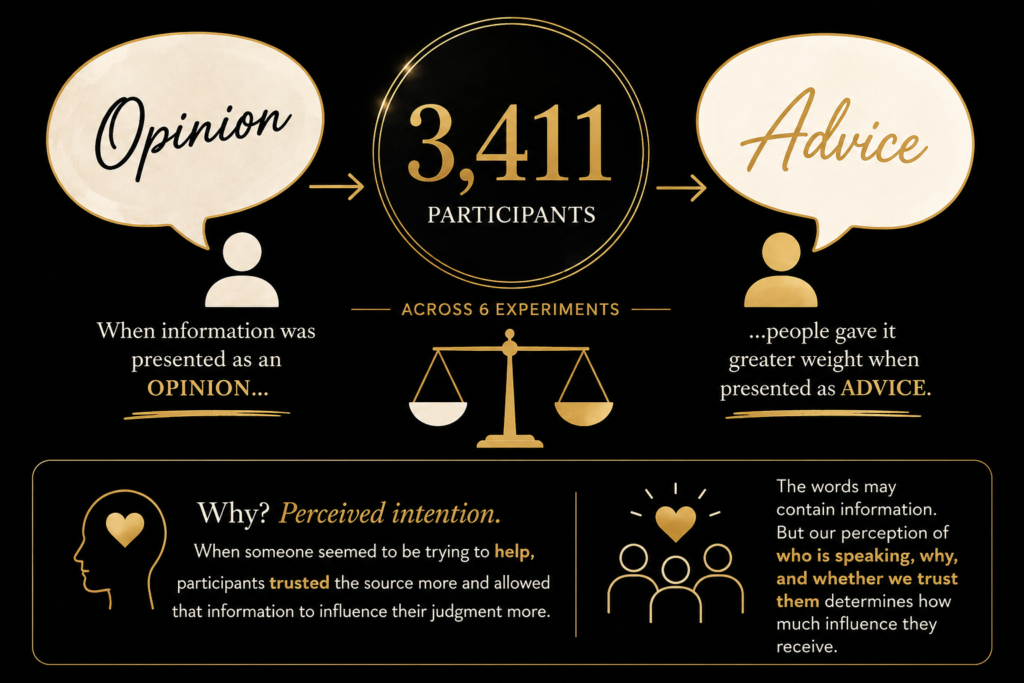
3,411
People responded differently when an opinion became “advice.”
Across six preregistered experiments involving 3,411 participants, researchers found that people gave greater weight to information when it was presented as advice rather than simply another person’s opinion.
Why?
Part of the effect appeared to come from perceived intention. When someone seemed to be trying to help, participants regarded the source as more trustworthy—and allowed that person’s information to influence their judgment more.
The words may contain information.
But our perception of who is speaking, why they’re speaking, and whether we trust them helps determine how much influence those words receive.
His Perspective
One thoughtful conversation. One man’s perspective. One more lens through which to explore this issue.
When His Voice Becomes Background Noise
Based on a conversation with a man reflecting on trust and influence in relationships.
When a man is building a life with a woman he loves, he naturally wants his perspective to carry a unique weight with her. Not because no one else’s opinion matters, but because theirs is the relationship in which trust, commitment, and a shared life are being built.
That’s why it can be difficult when he offers a perspective that seems to go unheard, only for a friend to say something remarkably similar and suddenly have it carry weight. From his side, the frustration isn’t simply, “I said it first.” It’s wondering why an outside voice was able to reach her when his could not.
Over time, feeling repeatedly unheard can change more than the conversation. He may simply stop offering his perspective.
Sometimes silence isn’t agreement. It’s what remains when someone no longer believes his voice will matter.

Grace in Action
A life that beautifully reflects this issue’s central truth.
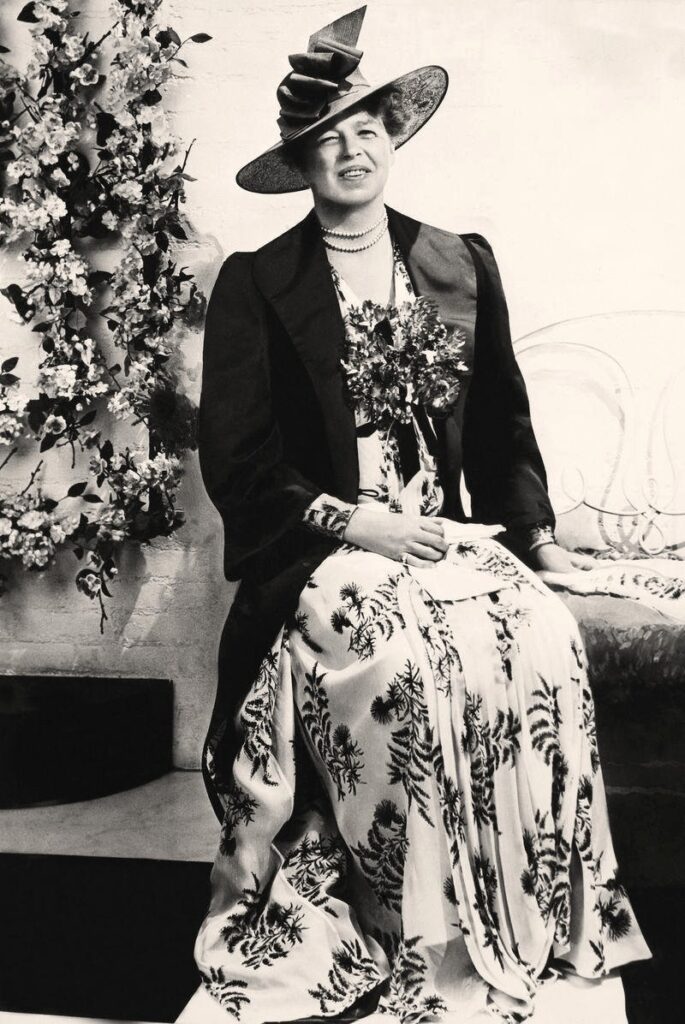
Eleanor Roosevelt: A Mind of Her Own
She listened widely—but learned to decide for herself.
Eleanor Roosevelt spent much of her life surrounded by powerful voices. As First Lady, she encountered politicians, advisers, activists, journalists, critics, and citizens with sharply different ideas about what mattered—and what her own role should be.
Yet she did something remarkable: she kept listening.
She traveled extensively, corresponded with people across the country, asked questions, and sought perspectives beyond the circles of power surrounding her. But listening did not mean surrendering her judgment. Over time, she developed convictions of her own, sometimes holding them even when they were unpopular or differed from those of people closest to her.
Her independence wasn’t built on refusing influence. It was built on becoming thoughtful about it.
Eleanor understood that other people could inform her without deciding for her. She could remain curious enough to reconsider and grounded enough to stand firm.
That balance is worth cultivating.
A discerning woman doesn’t need to silence the voices around her. She learns to listen without losing her own.
The Grace Challenge
This Week…
Before discussing a frustration about someone else, pause and ask yourself:
What am I hoping to get from this conversation—wisdom, perspective, validation, or an ally?
Then choose your next step intentionally.
If you need perspective, seek someone who will help you see clearly—not simply agree. If you need wisdom, choose someone whose judgment you genuinely respect. And if what you really want is validation or an ally, consider whether the conversation needs to happen at all.
Did I seek clarity this week—or simply confirmation?
Further Reflection
A Voice Audit
Think about the people whose opinions influence you most—friends, family, your partner, coworkers, online voices, or even people you don’t personally know.
Write down the three to five voices you find yourself returning to most often.
Beside each one, ask :
• Do I trust this person’s judgment—or simply their loyalty to me?
• Can they disagree with me without losing my trust?
• Does their influence make me wiser, calmer, and more accountable?
• Have they earned the amount of influence I give them?
Then ask one final question :
• Is there someone whose voice I should be hearing more—or someone whose voice has been given too much weight?
Enjoyed this issue?
Receive each new issue of The Grace Wins Journal in your inbox.
Share this issue.
Know someone who might appreciate this conversation?