

THE GRACE WINS JOURNAL
Issue No. 1 • August 1, 2026
Where Does Your Worth Come From?
Self-Respect vs. Self-Importance
Character • Psychology • Relationships
We live in an age that constantly tells us to “know our worth.” But what happens when self-worth becomes dependent on attention, admiration, or being treated as exceptional?
This inaugural issue explores the quiet difference between secure self-respect and the need to feel important—and why understanding that difference can transform both our relationships and our lives.


The Conversation
We live in an age that constantly tells us to “know our worth.” On its face, that’s good advice. Every person possesses inherent dignity and should never tolerate abuse or believe they are less valuable than they truly are.
But somewhere along the way, our culture quietly began confusing self-respect with self-importance.
They sound similar. They are not.
One produces peace. The other produces comparison.
One attracts healthy relationships. The other quietly erodes them.
At first glance, self-respect and self-importance can look remarkably alike. Both may appear confident. Both may set boundaries. Both may refuse to accept poor treatment.
The difference isn’t how they appear.
The difference is where they draw their worth.
A woman with healthy self-respect doesn’t believe she’s valuable because she is admired, chosen, attractive, successful, or constantly affirmed. She understands that her worth is inherent. It doesn’t rise with praise or fall with criticism.
A woman driven by self-importance, however, often finds herself searching for something different—not worth itself, but proof of it.
And that’s where the trouble begins.
The Quiet Shift
Self-importance rarely appears overnight.
It usually begins much more subtly.
We all enjoy encouragement. We appreciate being noticed. We feel good when our efforts are recognized. There is nothing unhealthy about that.
The problem begins when appreciation slowly becomes expectation.
When compliments become necessary. When recognition becomes deserved. When admiration becomes something we believe others owe us.
Psychologists have long observed that people naturally compare themselves to those around them. Comparison, by itself, is part of being human.
But comparison has a quiet way of changing the questions we ask.
Instead of asking, “Am I growing?”
we begin asking, “Am I ahead?”
Instead of celebrating someone else’s success, we quietly measure it against our own.
Instead of finding contentment, we begin chasing validation.
Without realizing it, we can start building our identity on the opinions of others.
The irony is that someone who appears exceptionally confident may actually possess a confidence that feels fragile beneath the surface. When our worth depends on admiration, every criticism feels personal, every disappointment feels larger than it is, and every success must continually be repeated to reassure us that we are enough.
The Quiet Strength of Self-Respect
Healthy self-respect looks different.
It doesn’t need to win every argument.
It can celebrate someone else’s success without feeling diminished.
It receives compliments with gratitude but doesn’t depend on them.
It admits mistakes because being wrong doesn’t threaten its identity.
It apologizes without becoming smaller. It serves without needing recognition. It loves without keeping score.
That kind of confidence is quiet because it has nothing to prove.
It isn’t thinking less of yourself. It isn’t thinking more of yourself.
It’s thinking of yourself truthfully.
A Better Question
Perhaps the most important question isn’t, “Do I know my worth?”
Perhaps it’s, “Where does my worth come from?”
If our answer depends on beauty, popularity, accomplishments, relationships, social media approval, or the opinions of others, we’ll spend our lives chasing something that can never truly satisfy.
But if our worth is rooted in something deeper—something that cannot be taken away—we become free.
Free from comparison.
Free from envy.
Free from constantly proving ourselves.
Free to celebrate others.
Free to grow.
Free to love.
And perhaps that is the quiet strength of self-respect.
Reflection
This week, ask yourself one simple question:
Where have I been looking for proof of my worth?
And what might change if you no longer needed to prove it at all?
By the Numbers
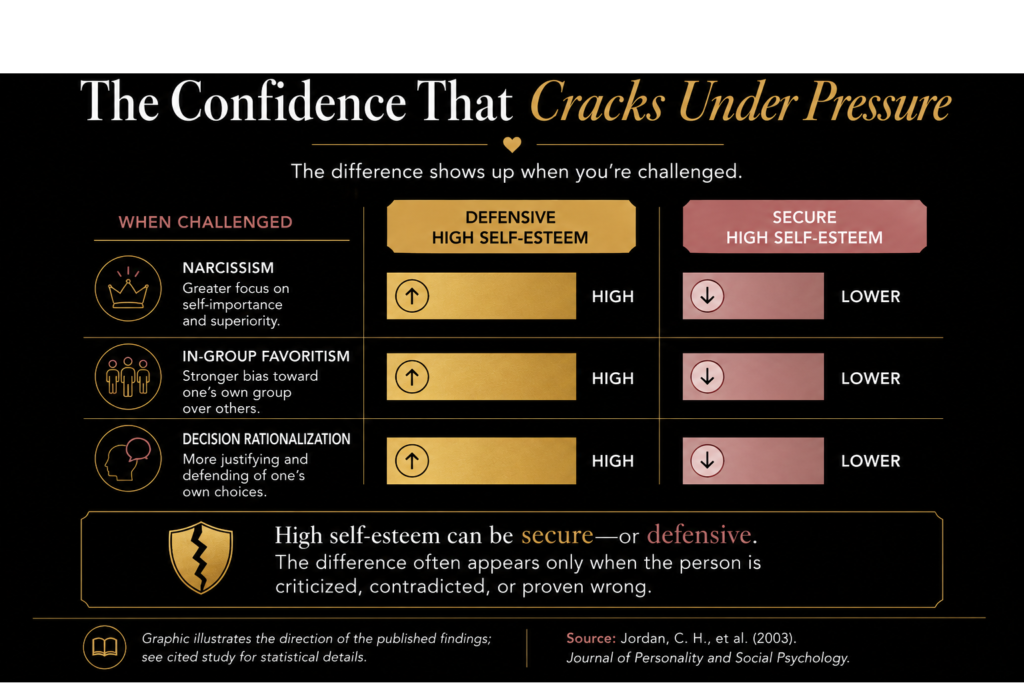
Across three psychological studies, researchers found that people with a more defensive form of high self-esteem were more likely to respond with narcissistic attitudes, stronger favoritism toward their own group, and greater rationalization after making decisions than those whose confidence appeared more secure.
What this really means
Confidence isn’t measured only by how highly we think of ourselves.
It is also revealed by how we respond when our self-image is challenged.
Secure confidence can withstand correction without collapsing.
Defensive confidence often feels compelled to protect itself.
Perhaps the strongest confidence isn’t the one that never gets questioned.
It’s the one that doesn’t need defending.
Adapted from Jordan et al., “Secure and Defensive High Self-Esteem,” Journal of Personality and Social Psychology (2003).
His Perspective
One thoughtful conversation. One man’s perspective. One more lens through which to explore this issue.
Why Quiet Confidence Stands Out
Based on a conversation with a husband of twenty-three years.
There is something deeply attractive about a woman who is comfortable in her own skin.
Not because she demands attention…
…but because she doesn’t seem to need it.
When we talked about confidence, he admitted that many men find themselves surprisingly drawn to women who celebrate other people easily, admit mistakes without defensiveness, and aren’t constantly comparing themselves to everyone around them.
“It feels peaceful,” he said.
“You’re around someone who doesn’t seem like they’re competing with the world.”
He wasn’t describing perfection.
He was describing security.
…

Grace in Action
A life that beautifully reflects this issue’s central truth.

Ruth: The Quiet Strength of Knowing Your Worth
Ruth’s story begins in loss. Widowed, far from home, and facing an uncertain future, she had every reason to believe her worth had diminished. Instead, she chose loyalty over convenience, following Naomi into an unfamiliar land with quiet courage and unwavering faith.
In Bethlehem, Ruth did not seek recognition or expect others to rescue her. She humbly gathered grain in the fields, embracing honest work without believing it lessened her dignity. It was there that Boaz first noticed her—not because she demanded attention, but because her kindness, humility, and character had already become known.
Ruth reminds us that genuine self-respect doesn’t need applause. It quietly shapes our choices, trusting that character matters even when no one is watching. Long before she became Boaz’s wife or part of the lineage of Christ, Ruth had already become a woman worthy of admiration.
She didn’t build her life by seeking importance. She built it through grace.
“Self-respect isn’t the need to convince others of your value. It is the quiet confidence to live according to your values, whether anyone notices or not.”
The Grace Challenge
This Week…
Choose one situation this week where you would normally seek recognition, validation, or reassurance.
Instead, quietly choose character.
Perhaps that means serving without expecting thanks. Celebrating someone else’s success without comparison. Admitting a mistake without defending yourself. Or offering kindness that no one else will ever notice.
At the end of the week, ask yourself:
Did I spend more energy proving my worth—or living from it?
Further Reflection
“Self-respect is quiet. It has nothing to prove.”
Journal Prompt
When do I most feel the need to prove my worth?
What would change if I truly believed my value could not be increased by praise—or diminished by criticism?
This Week’s Thought
The strongest people are often the least concerned with appearing strong.
Enjoyed this issue?
Receive each new issue of The Grace Wins Journal in your inbox.